
Recap: A Conversation with Gordon Dean Cooper and Rebecca Taylor
Most HR leaders can feel it: the job they were hired to do is not the job they're doing anymore.
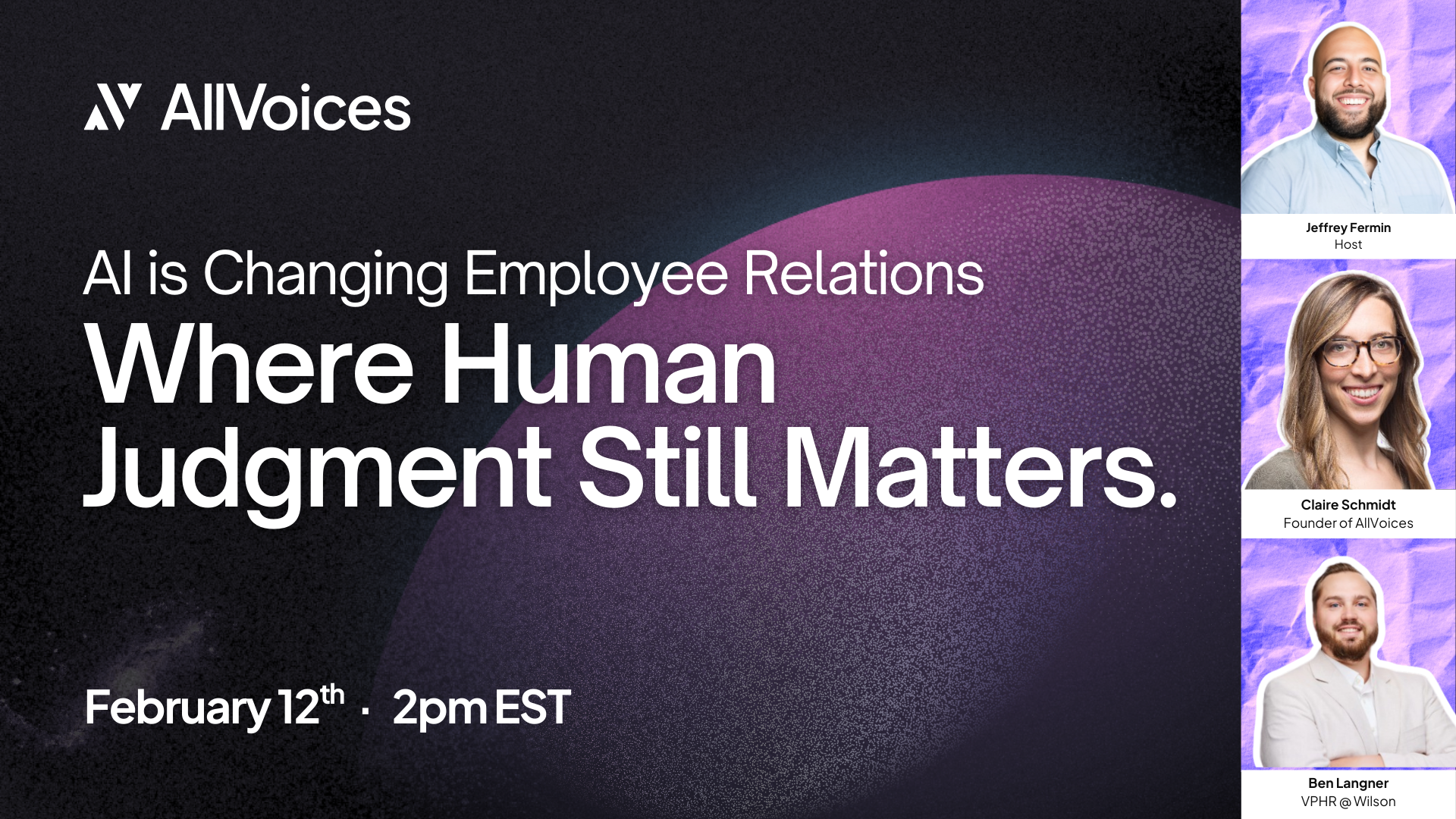
That shift was the starting point for our latest webinar, featuring Gordon Dean Cooper (Former VP of HR, LVMH) and Rebecca Taylor (AllVoices), hosted by Jeffrey Fermin. The conversation covered how AI is fundamentally changing what HR is being asked to do, why the HRBP title might be doing more harm than good, and what it actually takes for HR to stop playing catch-up and start operating ahead of the curve.
Here's everything they covered.
AI Didn't Just Change HR's Job. It Created a New One.
Gordon set the tone early: the evolution of HR from personnel to human resources to business partner happened in incremental steps over decades. AI broke that pattern. This isn't another step. It's a fundamentally different job.
Every time a hiring manager says "we need to hire an X," the conversation is no longer just about finding the right candidate. It's about understanding which components of the role can be automated, which require a human, and how to design the job accordingly. And that's not just happening inside the HR function. HR is being asked to do that redesign work for every role across the organization.
Gordon raised a compensation question that most orgs haven't even started thinking about: if someone is really good at AI and has automated their job plus two other jobs, how is that being factored into job design, org design, and pay? If an individual contributor is managing 10 or 20 agents or bots, that's driving a huge chunk of productivity. But most organizations aren't recognizing or rewarding it yet.
Rebecca connected this to the broader shift happening across workplace culture. She referenced the Paul Rudd surf lesson scene from Forgetting Sarah Marshall: "you're doing too much, do less." Not do less for the sake of doing less, but because HR needs to figure out which parts of the job can be delegated to AI so there's room to think more strategically.
Her point: this isn't just an HR shift. It's a complete shift for the entire workforce. And HR is the function that has to figure it out for everyone else while figuring it out for itself at the same time. That tension between what HR is responsible for versus what employee relations actually covers is getting more complex by the day.
On top of all that, HR is often the only group in the room asking the hard questions about ethics, compliance, and bias in AI adoption. Rebecca noted that can create friction, especially when other departments are moving fast and experimenting. But that friction is tied to a really good business ethics outcome, and she wants to see HR empowered to lean into it more.
Gordon pushed back a bit: if HR is being called the stick in the mud, the profession should also ask whether it's showing up the right way. If the function is still acting as the policy police, that's a model from the seventies and eighties. HR is here to deliver value to a business. That requires some self-reflection about how the function is positioning itself.
Why the HR Business Partner Title Is Working Against the Profession
This was the segment that lit up the chat.
Gordon laid out his case: the HRBP title was absolutely the right thing when Dave Ulrich introduced it 30 years ago. It moved the needle. It gave the profession a framework to signal strategic relevance. But aspirational titles have a limit. At some point, they stop signaling intent and start advertising the absence of credibility.
His core argument: the word "partner" implies distance. It implies HR is alongside the business rather than inside it. You never hear "legal business partner" or "marketing business partner." Their authority and ownership are understood because the work makes it obvious. HR has earned the same level of credibility, but calling itself a partner to the business almost suggests it isn't part of the business.
HR is driving revenue, profitability, cost efficiency, and risk management every day. Those decisions show up on the P&L, the balance sheet, and the risk register. Continuing to assert strategic relevance through a title undermines the argument.
Gordon's take: VP of HR. Director of HR. Manager of HR. That's sufficient. The function has done the work. Stop labeling it and start demonstrating it.
Rebecca built on this with a practical angle: spending too much energy on how the function is perceived can actually hold it back. The business wants to see results. If the conversation stays focused on titles and positioning, the business is already moving on to the next agenda item. Her advice: act like the business partner, drive the business, embed yourself in it, and you'll start to be perceived the way you want to be perceived. You don't have to tell people what you are.
What It Actually Takes for HR to Earn a Seat at the Table
Both speakers kept coming back to language as the single biggest unlock.
Gordon shared a sharp example from his learning and development background: HR teams love talking about hours of training delivered. But that tells the business nothing except cost. What matters is the outcome. Revenue per agent up 12% after a training program? That's a story the C-suite cares about.
The same applies to recruiting. Time to fill is a backward-looking metric. What the business actually needs to hear is: for every month that sales leader role stays open, the company is giving up roughly 1.5% of revenue growth. Fill the role on time, and HR enabled that growth. That's the translation that changes the conversation. If you're looking to sharpen how you measure and communicate this kind of impact, tracking the right employee relations KPIs is a good starting point.
Gordon was candid: HR overall is not great at this. The profession tends to talk about its own metrics and initiatives rather than connecting them to business outcomes. The business doesn't care about HR metrics. It cares about what HR is driving. Until the function can demonstrate and talk about its business value, it can't expect the business to understand or translate it either.
Rebecca connected this directly to employee relations. If you're presenting case counts to leadership, they'll nod and move on. If you're showing which teams are generating risk and what that risk is costing the business, you're having a completely different conversation. Closing investigations faster means less potential legal cost. Mitigating risk sooner means fewer issues escalating into bigger problems. That's the story that moves leadership.
She also raised an important point about transparency: when HR is driving big change, telling the story of how a decision was made matters just as much as announcing it. Employees trust decisions more when they can understand the nuance behind them, even if they don't agree. That's change management 101: storytelling, champions, reinforcement. That kind of transparency is also a huge factor in improving employee quality of life across the board.
This is where centralized HR case management makes a real difference. When HR has visibility into what's trending across teams and managers, the data tells a story that leadership can act on. AllVoices surfaces those patterns in real time so HR isn't connecting dots after the fact.
How HR Actually Moves From Reactive to Proactive
Rebecca went straight to pattern recognition.
HR needs to see when smoke is actually a signal. If performance is dipping in a department, it's not always about the individual. Has there been a lack of investment? High turnover on the team? A market shift that's completely changed how someone has to do their job? The bigger picture matters, and small interventions made early have a much bigger lasting impact than cleaning up after something explodes.
Her advice: document everything. Not in a diary-of-complaints way, but because by the time someone walks into your office to talk about an issue, it's usually been building for a while. If you're not capturing those data points along the way, you won't have the patterns when you need them. Having a clear process for managing employee relations cases makes that documentation habit a lot more sustainable than emailing yourself notes.
Gordon agreed and added that HR is sitting on more data than it realizes but keeps it in silos. Performance management data that doesn't connect to learning and development. Succession planning that doesn't inform talent acquisition. When a team consistently shows a gap in a certain skill set, the next hire on that team should have that skill. But that connection only happens when the data is actually flowing between systems.
He shared a memorable example: an account executive at a previous organization who put almost 50,000 miles on her car in one year. At that point, the company was paying her to drive, not to sell. Using that mileage data to make the case for redesigning territory assignments was the kind of proactive, data-backed HR move that the business immediately understood.
Gordon's broader point: AllVoices is phenomenal at helping HR look at patterns and detect trends. But even beyond any single tool, HR has to get better at connecting the dots across the data it already has. That's a big miss for the profession right now. The current trends in employee relations are all pointing in this direction: away from reactive problem-solving and toward proactive pattern recognition.
Rebecca closed with the AI connection: this is exactly where AI can help HR think more future-forward instead of always looking backward. Forecasting, surfacing insights, flagging signals before they become crises. Provided the data powering those insights is valid and accurate, it becomes a real tool for proactive decision-making. That's what Vera, AllVoices' AI copilot, was built to do.
AllVoices centralizes ER case management, surfaces patterns across performance, leave, and employee relations data, and gives HR teams the visibility they need to brief leadership proactively rather than defensively. You can't be proactive with data you don't have.
What HR Leaders Should Take Away From This Session
The whole conversation kept circling back to the same tension: HR has earned its credibility. The question is whether the function has the infrastructure, the language, and the data to do the work that credibility now demands.
That means speaking in business terms, not HR metrics. It means connecting data across silos instead of reporting from them. It means recognizing patterns before they become crises. And it means having the tools to make all of that possible every day.
Want to see how AllVoices helps HR teams make that shift? Book a demo today.
Quick Recap

HR Has a New Job. Does It Have What It Needs?


Got more questions? Email us at support@allvoices.co and we'll respond ASAP.
Stay up to date on Employee Relations news
Sign up to our newsletter
.svg)
.svg)


.png)
Got more questions? Email us at support@allvoices.co and we'll respond ASAP.